⚡ Emergency roof repairs available 24/7 — Call now: 0173 224 1138
🤔 Roofing Advice · Tonbridge, Kent

Should You Repair or Replace Your Roof?

An honest, no-nonsense framework for the biggest roofing decision — worked through Tonbridge’s actual housing stock, both when to repair and when replacement is oversell.

📞 Call Now: 0173 224 1138

Tell us the job in 30 seconds. No pushy sales, no call-out fee.

20+
Years Local
143
5★ Reviews
24/7
Emergency
10yr
Guarantee

As a rule of thumb, repair when under about a third of the roof has failed, the fixings are sound and the underlay is intact; replace when failure is widespread, tiles lift by hand (nail sickness), or the underlay has perished. The honest test is cost per remaining year of roof life — a cheap repair on a dying roof is the most expensive option of all.

The short answer

Repair or Replace? Start With Extent

The single most useful question is: how much of the roof has actually failed? If the covering is sound across most of the roof and the trouble is confined to a few slipped tiles, a worn valley or tired flashing around a chimney, that is a repair — and replacing the whole roof would be a waste of good material. But once failure is widespread, or the things holding the roof together (the nails and the underlay) have given up, repairs stop being economic because you are paying repeatedly to patch a roof that is going to keep failing somewhere new.
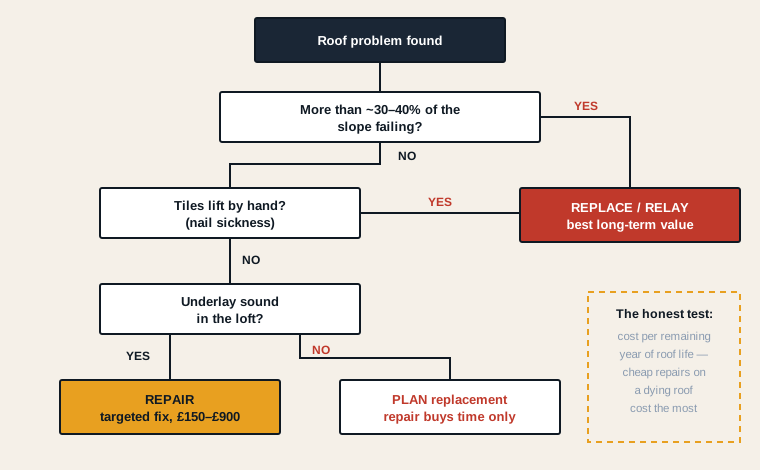
Repair or replace decision tree: extent of failure, fixings condition and underlay condition decide whether to repair, relay or replace a roof
How a roofer decides between a targeted repair, a strip-and-relay, and a full replacement.
Rule of thumb

The 30% Rule

Roofers often work to a rough guide: once more than about 30–40% of a slope has failed, tile-by-tile repair becomes false economy. Below that, targeted repairs are usually the sensible, cost-effective choice. It is only a rule of thumb — a roof with 20% failure but perished underlay and rusted fixings is a replacement, while a roof with localised storm damage over one bay may be a straightforward repair even if it looks dramatic. Extent matters, but so do the fixings and the underlay underneath.

Local knowledge

What This Means by Tonbridge Stock Era

Victorian and Edwardian terraces (Vale Road, Pembury Road, Quarry Hill). These clay plain-tile and slate roofs were built to last a century, and the tiles or slates themselves are often still perfectly good. What fails first is the fixings and the lead. A slate roof suffering nail sickness — where the original iron nails have rusted through and slates slip even though the slate is sound — is a classic strip-and-relay candidate: your original slate goes back on with new copper or stainless nails, typically 70–85% reusable. That is a replacement of the fixings, not the covering, and it is very different from a full tear-off.

Post-war concrete interlocking estates (Cage Green, Trench Wood, Higham Wood). Concrete tiles from the 1950s–70s have a shorter life than clay, and many across these estates are now reaching the end of it — surfaces spalling, tiles porous, dry-verge and bedding failing. Here, once a fair part of the slope is going, full replacement with modern interlocking tiles is usually better value than chasing failures one at a time.

Larger period roofs (Dry Hill Park). Welsh slate on the bigger villas can be relaid rather than replaced if the slate is sound; the decision hinges on the state of the battens, underlay and nails, which a loft inspection settles quickly.

The honest test

Cost Per Remaining Year

The fairest way to decide is not the price of the job in isolation but the cost per remaining year of roof life it buys. A £600 repair that buys two more years before the next failure costs you £300 a year. A £7,000 re-roof that lasts fifty years costs you £140 a year — and comes with a guarantee and no more emergency call-outs. Spend a little time thinking in these terms and the right answer usually becomes obvious. Cheap repairs on a roof that is fundamentally spent are, over time, the most expensive path of all, because you pay for them again and again and still end up replacing the roof.

When patching wastes money

When a Repair Is Money Wasted

Some honest red flags that a repair is throwing good money after bad: tiles that lift away in your hand across the roof (widespread nail sickness); underlay that crumbles or tears when touched in the loft; multiple leaks appearing in different places within a year or two; concrete tiles that are visibly porous, delaminating or heavily mossed across whole slopes; and a roof where every winter brings a new call-out. When two or more of these are true, a replacement or full relay is almost always the cheaper route once you count the repeated repair bills.

The other side

When Replacement Is Oversell

It works the other way too, and a trustworthy roofer will tell you so. If your tiles are sound, the underlay is intact and the fixings are holding, you do not need a new roof because one company’s salesman said so. A single slipped tile is a repair, not a re-roof. A tired but functioning valley can be rebuilt on its own. Moss can be cleaned and the roof left to run for years more. Flashing can be renewed around a chimney without touching the rest of the roof. If someone quotes a full replacement for a roof that a few hundred pounds of targeted work would settle, get a second opinion — and read our guide on how to choose a roofer so you know the questions to ask.

Not always binary

The Middle Ground: Relay, Single-Slope & Overhaul

Repair-or-replace is rarely a straight two-way choice, and the best value often sits in between. A strip-and-relay lifts the existing tiles or slates, renews the battens, underlay and fixings, and puts the sound covering back on — you get a roof that performs like new for a fraction of a full re-cover, and it is the go-to answer for nail-sick slate on the older terraces. A single-slope replacement makes sense where one aspect has weathered far worse than the rest: on exposed, higher ground around Southborough the south-west-facing slope takes the brunt of the prevailing wind and rain and can be spent while the sheltered slope has years left, so you replace only what needs it. An overhaul — re-fixing slipped tiles, re-bedding ridges and renewing flashings across the whole roof without new covering — can buy a sound-but-tired roof another decade cheaply. A good survey will tell you which of these fits, rather than defaulting to the biggest job.

Two things people miss

Insurance & Timing

Two practical points often tip the decision. First, sudden storm or impact damage is usually an insurance matter, not a maintenance one — if a gale strips a slope or a falling branch stoves in the tiles, that is a claim, and we document the damage with dated photographs and an itemised report so your insurer has what they need. Gradual wear-and-tear, by contrast, is rarely covered, which is exactly why letting a tired roof drift into failure is a false economy. Second, timing matters: a roof that is borderline is far better replaced in settled weather than nursed through another Kent winter, where driving rain and the odd frost will find every weakness. If your roof is marginal now, planning the work for spring or summer is cheaper and less stressful than an emergency re-roof in January after the ceiling has come down.

Get a Free, No-Obligation Quote

📞 Call 0173 224 1138
FAQs

Common Questions

It is a rough guide that once more than about 30 to 40 percent of a roof slope has failed, repairing tile by tile becomes false economy and replacement or a full relay is usually better value. Fixings and underlay condition can override it either way.

Often yes. Welsh slate frequently outlives its fixings, so a strip-and-relay refixes your original slate with new copper or stainless nails — typically 70 to 85 percent of a sound slate roof goes back on.

If your tiles are sound, the underlay is intact and only a small area has failed, you likely need a repair, not a re-roof. Get a second written opinion if a full replacement is quoted for localised damage.

Often, over time. Compare the cost per remaining year of roof life: repeated cheap repairs on a spent roof usually cost more than one replacement that lasts decades and carries a guarantee.

Not Sure Which You Need?

Book a free, honest survey. We will tell you plainly whether a repair will do — or whether replacement is the better value.

📞 0173 224 1138

See also: Roof Repairs · Roof Replacement · Roof Inspections